
Guaranteed Reach vs. Guaranteed Loss: Why Communities are Migrating Off Traditional Social Media Platforms
In the current digital landscape, every organization faces a critical strategic decision regarding its digital community infrastructure: Do we operate on a model built for external ad revenue, or on infrastructure built solely for our mission and member success? The choice is rapidly evolving from a matter of convenience to a high-stakes strategic trade-off: securing a predictable ROI through platform control, or accepting the inevitable decay of reach, member trust, and data security
For years, organizations’ strategies involved building digital communities on ad-driven social media platforms, the Ad-Tech Model. Organizations invested significant time, capital, and resource equity into platforms like Meta, LinkedIn, and X, trusting that their content and connection efforts would yield consistent, cost-effective returns. That model is now demonstrably broken.
Strategic leaders are realizing that community governance, control, and member trust are no longer negotiable features; they are fundamental elements of modern business infrastructure. This realization is driving organizations to migrate to platforms that align their ethical standards with their financial and long-term strategic goals.
1. The Business Model is the Conflict: Ad-Tech vs. Your Mission
The primary goal of Ad-Tech platforms, such as Facebook and LinkedIn, is to maximize shareholder revenue, including through advertisement monetization. This simple truth creates two structural conflicts for any organization that relies on them for community engagement:
Conflict A: Reach Control (The Operational Tax)
Ad-Tech platforms are financially incentivized to intentionally limit the organic reach of your content.
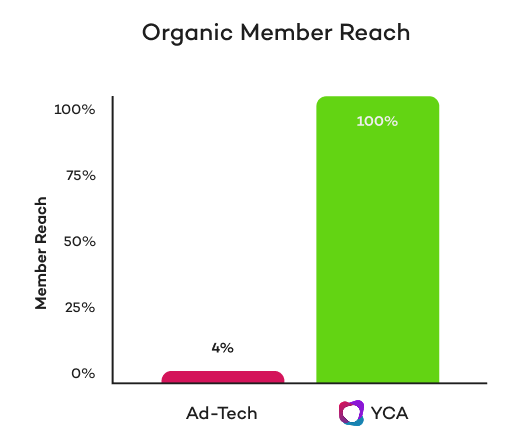
The Problem: Intentional Organic Decay. Data consistently shows organic reach for organizations on major platforms is in the low single digits (often 3%–5%). This is not an accident; it is an intentional design to optimize the platform’s profitability. The platform coerces organizations to purchase ads to communicate with the community they have already acquired through tactics such as shadow banning and deprioritizing content with external links.
The Consequence: The Hidden Cost of Dependency. Your community strategy budget is burdened by ad expenditure. You are forced to pay a middleman (the platform) to reach your own members. This maximizes the platform's ROI, but guarantees a drain on your operational budget.
Conflict B: Data Extraction & Targeting (The Fiduciary Risk)
The Ad-Tech platform’s secondary revenue stream is the user data itself.
The Problem: Data Forfeiture. Ad-Tech platforms extract and analyze every user conversation, click, and interaction to sell to advertisers. Your members' behaviors, interests, and private discussions become data points for monetization.
The Consequence: Erosion of Trust and Brand Liability. Member trust in the organization fractures when constituents realize their posts or discussions are being mined for commercial targeting. Public trust in social media platforms is already eroding due to modern privacy practices, causing organizations on these platforms to incur a high cost to member loyalty and organizational goodwill.
2. The Strategic Risk of External Dependency
Relying on an external Ad-Tech platform translates directly to strategic and financial risks, converting your community from a managed asset into a volatile liability:
Volatile ROI and Unpredictable Budgeting
Community success and marketing budgets are beholden to the platform’s next arbitrary algorithm change, shifting content moderation policy, or sudden spikes in ad costs. Connection to members is volatile and subject to external factors, making long-term strategic planning and ROI forecasting difficult.
Strategic Dissonance and Mission Drift
Your organization is placed in an ethical and operational bind, forced to coexist with a commercial partner that views your members as mere revenue sources, rather than long-term constituents for a shared mission. This dissonance degrades your brand’s goodwill and creates internal friction regarding digital ethics and governance.
Loss of Strategic Asset Control
In the Ad-Tech model, your community data is a commodity used to optimize the platform’s bottom line, not yours. This creates a critical IP leak: the Ad-Tech platform gains a more intimate understanding of your members than you do. To secure your mission, your community data must be treated as a Secured Asset, hosted securely, but governed entirely by your policies. This ensures you retain the exclusive power to leverage your data for member retention and growth, rather than allowing a platform to monetize your most valuable intellectual property.
3. The Solution: Business Model Alignment and Guaranteed ROI
The solution is to migrate to a Community-Tech platform where the business model is inherently aligned with your mission. This means decoupling community success from ad revenue and building on a foundation of guaranteed reach, data ownership, and strategic control. Community-Tech platforms, like YCA, provide the ethical, financial, and strategic alignment your mission demands.
I. Full Data Control: Your Data as a Secured Asset
Strategic Data Ownership: Your community’s data, the member profiles, the discussions, and the engagement analytics are yours. It is treated as private intellectual property and is never monetized as external ad inventory.
Empowered Decision-Making: You gain access to comprehensive data and analytics dashboards to guide your strategy. This data enhances your mission and informs your roadmap, rather than becoming a commodity sold to external advertisers.

II. Guaranteed Reach, Predictable Investment
Unrestricted Reach: By eliminating the Ad-Tech middleman, you eliminate organic decay. Your posts are visible to 100% of your community members, maximizing the impact of every piece of content.
Financial Predictability: Moving to a fixed-fee investment model for dedicated Community-Tech eliminates the hidden, variable costs of ad spend. The financial case is clear: a fixed investment in a mission-aligned platform transforms volatile ad expenditure into an investment that guarantees ROI.
III. Ethical Foundation and Unrestricted Action
Ethical Foundation: Community-Tech offers the ethical standard your members expect regarding privacy and data ownership. This business model alignment resolves the systemic trust erosion in Ad-Tech platforms.
Full Control: You set the rules, policies, and direction for your community, securing your mission from external algorithm changes and content moderation policies. This shift moves your organization from a state of platform dependency to one of complete asset authority, where you hold the exclusive power to direct how your community data and member connections are managed.
Ready to Secure Your Mission?
Organizations are realizing that ceding control of their most valuable asset, the connection with their members, to an Ad-Tech model is no longer viable. To move from the risks of guaranteed loss of reach, trust, and control to the certainty of guaranteed reach and predictable ROI, the time to invest in mission-aligned infrastructure is now.
YCA: Software Designed for Mission-Critical Community. Take Control of Your Community Data and Future.
Request a Demo Today. See how YCA can secure your mission, guarantee your member reach, and transform your community from a volatile dependency into a secured, strategic asset.

